

articles

Case History: Room Acoustics Exciting Destructive Vibration at a Nuclear Power Plant
By: Mechanical Solutions, Inc.
Tel: 973-326-9920
Email
Mr. William Marscher, PE, CEO of Mechanical Solutions, Inc.
View Profile on Experts.com.
Mechanical Solutions, Inc. (MSI) was contracted to determine the root cause and solution for the failure of 4 kV switchgear bearings in a nuclear power facility. The switchgear cabinets were shaking at the frequency of the turbine/ generator mounted on the deck above, even though the floor of the switchgear cabinets had an extremely low level of vibration. Who was at fault? The major engineering/ procurement/construction (EPC) firm, the switchgear manufacturer or installer, or the turbine-generator OEM? How could the problem be eliminated, and would the plant be responsible for bearing the cost?
MSI engineers noticed, as they walked through the large building on the switchgear floor level, that a throbbing sensation could be sensed at regular intervals, following a 3-D “checkerboard” pattern. An experimental-data-based model was constructed over a period of several days of testing, which consisted of both hundreds of accelerometer measurements on the turbine deck machinery and decking, as well as on the switchgear cabinets and floor. In addition, MSI took sound pressure level data at hundreds of locations in three dimensions, in the switchgear room, and surrounding areas. All of the vibration motion as well as pressure pulsation was recorded and played back by superimposing the scaled-up amplitude, as well as relative phasing versus a common reference (at a selected location and direction on the top of the generator exciter). The results were animated, a “snapshot” from which is provided in the figure:
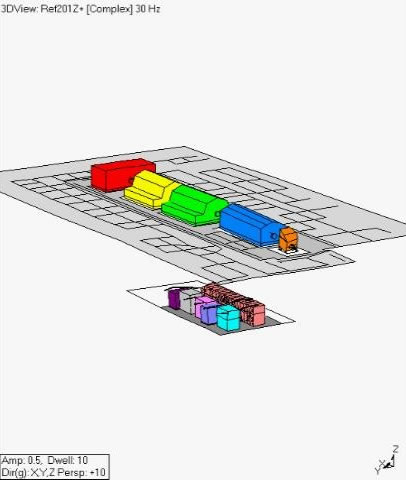
The information value of the animation was extraordinary. It showed clearly that the 30 Hz exciter was acting as a vibration shaker, drumming the turbine deck, which was responding with a “rug-flapping” mode at 30 Hz. The undulating motion of the turbine deck drove an acoustic mode of the switchgear floor-level, the air “glowing” red and blue (for clarity, not plotted in the figure above) at acoustic antinode points in concert with the motion of the floor motion. In turn, the switchgear cabinet wall panels pulsed in and out in concert with the 30 Hz acoustic pressure pulsations next to each cabinet.
Once this combined structural/ acoustic “Operating Deflection Shape” (ODS) was discerned from the test results, impact modal testing was performed on the various machines and floor of the turbine deck, as well as on the switchgear cabinet panels. The impact testing was all performed with low enough energy to not harm or trip the equipment, and was performed while the equipment remained operating, using MSI’s TAPTM time-averaged pulse technique. The modal testing confirmed that the switchgear high-vibration panels, the turbine deck, and the generator exciter all had a “perfect storm” of natural frequencies close to 30 Hz. Finally, pulsing sound from a temporarily-placed loud speaker confirmed the acoustic natural frequency of the switchgear room at 30 Hz.
A detailed operating deflection shape (ODS) as well as modal test of the exciter exhibited back-and-forth rocking motion. A structural natural frequency at approximately 30 Hz was identified as having tuned into resonance due to one of the feet of the exciter becoming flexible or “soft” with time. The resulting exciter motion, driven by typically acceptable levels of residual imbalance, excited the turbine deck resonance, which excited the switchgear floor-level acoustic resonance, which excited the switchgear panel resonances, which were damaging the switchgear bearings. Only detailed testing could have unraveled this complex mystery. With the root cause was known, a simple and practical solution was identified- it was only necessary to simply repair the exciter degraded attachment! There was no E & O problem with the design or original installation after all.
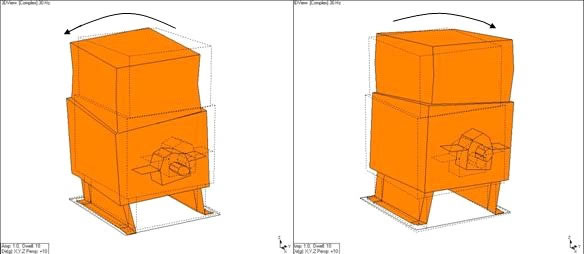
Snapshots showing the rocking motion of the exciter at 30 Hz
The combined acoustic-structural resonant vibration of the switchgear was addressed by bypassing the exciter loose foot. This de-tuned the natural frequency from the 30 Hz excitation, dramatically reduced switchgear vibration, and eliminated the switchgear reliability issues without the need to pre-maturely shut the plant down. The time and expense of a lawsuit was avoided.
Mechanical Solutions, Inc. (MSI), performs litigation support through its extensive engineering capabilities, and when required, through expert testimony. MSI uses advanced finite element analysis (FEA), rotor dynamics, and torsional analysis tools, and uses computational fluid dynamics (CFD) to analyze 3-D steady or unsteady fluid flows and heat transfer, enabled by its 230 high speed processor supercomputers. Its areas of expertise range from new equipment design and forensic analysis to hydraulic turbine generators and aircraft gas turbine engines.
©Copyright - All Rights Reserved
DO NOT REPRODUCE WITHOUT WRITTEN PERMISSION BY AUTHOR.
Related articles

Follow us


